Blog · By the Simplify and Grow AI team · Oct 25, 2026
Most owners say AI isn't paying off yet. Here's the one-bottleneck way to change that.
You've probably tried it. Maybe ChatGPT wrote a few emails, or you switched on the AI feature in your scheduling app. Then Monday came and the week ran the way it always does. That usually comes down to where you started.
The gap: lots of tools, same workflow
In Bluevine's 2026 survey of 942 U.S. small business owners, 74% said they're already using or testing AI tools. Among owners who use AI, 52% report a return on their investment and 24% say they haven't seen a return yet.
82% have hit at least one barrier to using AI more deeply, led by data security concerns (33%) and not trusting AI's accuracy (31%). The same survey found 78% of owners don't fully trust AI to handle low-level tasks without oversight, even though those are the tasks that would save them the most time.
Why one more tool rarely fixes it
One job might start as a phone call, turn into a text, get written up in your field software, become a quote in a spreadsheet, and get tracked in your head. The AI tool you bought sits in one of those places, and the delays happen between them:
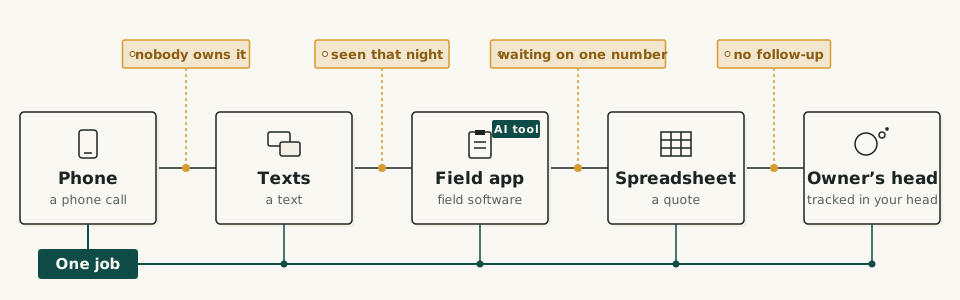
- A request came in, and nobody owned it until you saw it that night.
- An estimate sat half done, waiting on one number from the field.
- A quote went out, and nobody followed up.
A chatbot can write a nicer email. It can't notice a quote has sat for three days, pull the details from two apps, and put a follow-up in front of the right person unless someone connects those steps.
Trust gets easier when AI has one defined job and a person approves the result, so you can see what it did.
The one-bottleneck approach
Instead of asking where you could use AI, ask where work waits the longest. Every business has a step where things pile up, usually behind one busy person, and often that person is you. Fix that step and the work behind it moves faster.
- Pick the longest wait. Find the step where a customer, a teammate, or a payment sits.
- Measure it this week. Count how often it happened and how long each one waited.
- Fix only that. Automate the handoffs and reminders around it, keep a person on the decision, and measure again before you move to the next one.
A worked example: the estimate that sits for three days
This is an illustrative example, not a client story.
The pattern shows up across industries. Here's one home-services version: a customer asks for a repair estimate. The tech visits, takes photos and notes, and heads to the next job.
Often it looks like this:
- Day 1: The notes sit in the tech's phone while the owner is on jobs all day.
- Day 2: The owner starts the estimate at night, gets interrupted, and leaves it as a draft.
- Day 3: The estimate goes out with no follow-up reminder.
- Day 7: The customer has hired whoever got back to them first.
After you automate around that step:
- When the tech closes the visit, the notes and photos go into a draft estimate built from the company's own pricing.
- The owner gets a short summary, edits the draft, and approves it. Nothing reaches the customer without that approval.
- If the customer hasn't replied after a set number of days, a follow-up draft shows up for approval.
- A weekly list shows what was sent and what's still waiting.
The owner still sets the price, and the crew didn't have to learn a new app. Because the owner counted how long estimates sat before the change, they can tell whether it worked.
Our home services page has more examples of where work stalls.
Find your bottleneck in about 20 minutes
Grab a notepad and walk one job from first contact to payment.
- Write down every step, who does it, and which app or inbox it lives in.
- Circle every step where the job waits, and guess how long: hours or days?
- Mark the steps where someone retypes information from one place to another.
- Note whose name sits next to most of the circles. If it's yours, that's normal.
- For the biggest circle, write down what you'd want to check before anything reaches a customer.
Your first bottleneck is the circle with the longest wait, the most retyping, and your name on it. Our free Blueprint questions go through the same thinking in more depth.
Start with one bottleneck
If you're in the 24% who haven't seen AI pay off yet, another tool probably won't change that. Pick one place where work waits, measure it, and fix that step inside the software you already use, with you approving what matters.
Our free Simplify Blueprint is a 30 to 60 minute working session where we map how work moves through your business, find what's eating your week, and hand you a one-page plan for the first fix. The plan is yours whether you work with us or not.
Book your free Simplify Blueprint
Simplify the work. Grow the business.
Source: Bluevine, "Small Business AI Trends Report 2026," survey of 942 U.S. small business owners and financial decision-makers, fielded April 7 to 9, 2026 by Centiment. https://www.bluevine.com/blog/small-business-ai-trends-report-2026